Soil & Water Conservation Program
Watch a short video of the Missouri Soil and Water
Districts Commission's
Tour of Lincoln University's
George Washington Carver Farm
near Jefferson City. (Length 2:33)
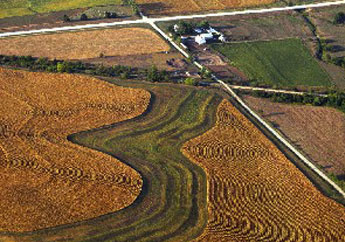
The Soil and Water Conservation Program, or SWCP, provides financial incentives to landowners to implement conservation practices that help prevent soil erosion and protect water resources. By promoting good farming techniques that help keep soil on the fields and waters clean, the program helps conserve the productivity of Missouri’s working lands.
Assistance offered by the Soil and Water Conservation Program includes:
Cost-Share Program
This program provides incentives for landowners to install conservation practices that prevent or control excessive erosion and protect water quality. Landowners can receive up to 75 percent of the estimated cost of the practice to be reimbursed after the practice has gone through a certification process. For your convenience we have information on how to begin a cost-share practice, online.
Agricultural Nonpoint Source Special Area Land Treatment (AgNPS SALT) Program
These long-term projects focus on decreasing agricultural nonpoint source pollution in watersheds. AgNPS SALT uses watershed planning to reach goals established to decrease sediments, pesticides and nutrients entering waterways.
District Grants
Each of the 114 soil and water conservation districts (SWCDs) in Missouri receives a district grant to hire personnel, fund technical assistance and provide information and education programs.
The department’s Soil and Water Conservation Program also provides funding for university research, district benefits and administrative costs. The program receives no general revenue funding for soil and water conservation efforts.
Mississippi River Basin Healthy Watersheds Initiative
The Mississippi River Basin Healthy Watersheds Initiative, or MRBI is a 12-state effort funded by the USDA's Natural Resources Conservation Service to address nutrient loading in the Mississippi River Basin from its source in Minnesota to its mouth in the Gulf of Mexico. Among other water quality problems, agricultural runoff and other sources of nutients ultimately contribute to a lack of oxygen downstream in the so-called "dead zone" near where the Mississippi River empties into the Gulf of Mexico.
In the summer of 2010, the department coordinated development of project proposals from Missouri soil and water conservation districts for the MRBI. Proposals resulted in 12 Missouri projects being awarded $6 million in 2010 and $28.3 million in funding over the next four years. The federal funds will be used along with state, local, and private funds to provide cost-share payments to help agricultural producers install conservation practices to reduce nutrient and sediment runoff from agricultural land.
Mission Statement
The mission of the Soil and Water Conservation Program is to administer the policies and general programs developed by the Soil and Water Districts Commission for the saving of Missouri soil and water through the soil and water conservation districts in their work with landowners.
The primary funding for these cost-share practices comes from the one-tenth-of-one-percent parks, soils and water sales tax, which is shared by the Department of Natural Resources’ Soil and Water Conservation Program and the Division of State Parks