Geological Survey Program
Earthquakes in Missouri
Great Central U.S. ShakeOut! | Earthquake Science | SEMA Preparedness | FEMA Preparedness | FEMA Mitigation
Recent Earthquakes | Earthquake Awareness Month Activities | Preparedness Videos Created by Students
Earthquakes occur in our state
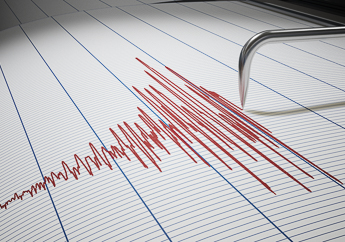
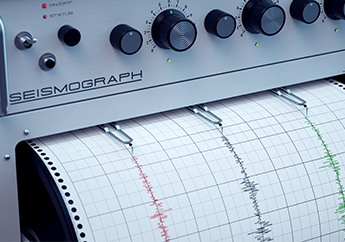
Missourians experience small earthquakes daily. This is especially true in southeast Missouri. The size of these earthquakes are in the range of 1-2 magnitude which means that they rarely are felt by humans; but they can be recorded on devices that measure the earth's movement. These earthquakes are evidence that a seismically active fault system is present in the southeastern portion of our state. This system is called the New Madrid Seismic Zone and it extends through a multi-state area. The movement along this fault system occurs thousands of feet below ground surface. However, because of both the extent and depth of this fault, it has the potential to cause damage and impacts across a large area of the central United States.
Geologic studies indicate that large earthquakes occurred along the New Madrid Seismic Zone in approximately 300 AD, 900 AD, and 1400 AD. Most Missourians have heard of the more recent 1811-1812 flurry of quakes that were in the range of magnitude 7-8 and centered near New Madrid, Missouri. Because few people lived in Missouri in the early 1800s, impact to human life was minimal. The three major earthquakes in late 1811 and early 1812, however, did permanently change the course of the Mississippi River and created the Reelfoot Lake in the northwest corner of Tennessee.
Missourians should be aware of the reality of earthquake hazards in our state. However, we must also understand that an earthquake measuring as large as 10.5 as depicted in disaster films, are probably only fiction. Some scientists predict that there is about a 10 percent chance of a magnitude 7-8 earthquake along the New Madrid Seismic Zone in a 50 year time interval; which is a more realistic estimation of the size of a large earthquake that may occur in our state. The most valuable lesson we can learn from watching natural disaster movies is that knowledge and preparation are key. We should channel the energy associated with an increased awareness level into positive activities that will help prepare for actual earthquake risk associated with the New Madrid Seismic Zone. The Division of Geology and Land Survey has worked cooperatively with the U.S. Geological Survey for several decades to increase the knowledge base about earthquakes in the central United States. For additional information, booklets or answers to questions, please contact the Division of Geology and Land Survey 573-368-2143. We are located in Rolla, Missouri at 111 Fairgrounds Road.
Join us for the Great Central U.S. ShakeOut -- Tuesday, Feb. 7, 2012 at 10:15 a.m.
Tuesday, Feb. 7, 2012, at 10:15 a.m. (CST), more than one million people across nine states will particiaption in the 2012 Great Central U.S. ShakeOut, earthquake drill. Will you be one who particiates? Register today and tell your friends! We hope you joined us last year when more than 3 million people in an eleven-state region registered to participate in the largest earthquake preparedness exercise in Central U.S. history.
Earthquake Facts
- Facts About New Madrid Seismic Zone
- History of Earthquakes in Missouri
- Understanding Earthquakes
- Measuring Earthquakes
- Relationship of Increasing Magnitudes
- Relationship Between Richter Magnitude and Modified Mercalli Intensity
- Recent Earthquakes in Central US
- What to do before, during and after an earthquake
- Earthquake Hazard in the New Madrid Seismic Zone Remains a Concern
- Eyewitness Accounts of the 1811-12 New Madrid Earthquakes
- Did you feel it?
- Missouri Seismic Safety Commission
- Additional Links
In the News
-
USArray Transportable Array seismic stations are being located in Missouri -- Find one near you! - Active Earth Kiosk makes debut in Rolla
- Joe Gillman, state geologist and Geology and Land Survey Division director, MoDNR, is coordinator for the Association of Central United States Earthquake Consortium (CUSEC) State Geologists.
- Arkansas earthquakes -- Recent activity in Arkansas. Updates from the Arkansas Geological Survey.
Sunday, Nov. 7, 2010 -- A Magnitude 2.8 earthquake occurred near Cape Girardeau 11:37 p.m.
25 km (15 miles) SW of Cape Girardeau, Missouri
35 km (20 miles) NNW of Sikeston, Missouri
170 km (105 miles) SSE of St. Louis, Missouri
265 km (165 miles) SE of Jefferson City, Missouri
Sunday, Nov. 7, 2010 -- A magnitude 2.8 earthquake occurred near Cape Girardeau 11:37 p.m. Details, Maps,
Did you feel this earthquake? Report shaking and damage at your location. You can also view a map displaying accumulated data from your report and others.
Articles, videos, fact sheets and maps
- Earthquake Hazard in the New Madrid Seismic Zone Remains a Concern
There is broad agreement in the scientific community that a continuing concern exists for a major destructive earthquake in the New madrid Seismic Zone. - Earthquakes in the News A list of news articles (searchable) compiled by the Central United States Earthquake Consortium.

- Make a commitment to being "Earthquake Prepared" --From MEI--A publication by Associated Industries of Missouri.
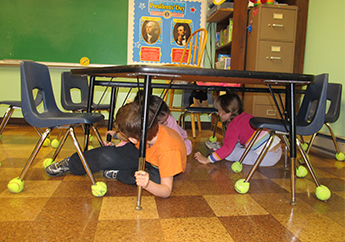
- Drop Cover and Hold Video -- Earthquake Safety in Schools Watch | Download (Duration 13 minutes, 30 seconds)
- Earthquake Hazards Maps
Projects and Partners
- St. Louis Earthquake Hazard Mapping Project
- Central United States Earthquake Consortium
- Center for Earthquake Research and Information (CERI)
- State Emergency Management Agency (SEMA)
- St. Louis University Earthquake Center
Tools and Locators
- Did you feel it? -- Report an earthquake to the U.S. Geological Survey
- Seismic Stations in Missouri
- Magnitude Calculator -- A magnitude 8 earthquake is 1,000 times BIGGER on a seismogram than a magnitude 5 earthquake. Try it yourself.